


Why the handicap matters more than the moneyline
Years ago I watched a punter walk away from a Premiership window because the Saracens moneyline was 1.10. He shrugged, said there was no value, and missed the fact that the handicap on the same match was paying near coin-flip odds. That moment shaped how I look at rugby pricing. Lopsided matches are not unprofitable — they are mispriced in a different market.
Handicap betting is the lever that turns mismatches into tradeable contests. Instead of asking which side wins, you ask by how much. The bookmaker imposes a points head-start on the underdog, and your job is to decide whether the favourite covers it. In rugby — where scorelines blow out faster than in most ball sports — that single adjustment changes the entire mathematics of a bet.
Match-outcome and margin betting account for roughly 60% of all rugby wagers globally, which tells you the handicap and its cousins drive an enormous share of the action. Get the line right, and you have a sharper read of the match than the bookmaker did.
How the line is set
A handicap line is not a guess. It is the median outcome of a match as modelled by the trader pricing it — usually a power-rating differential adjusted for venue, weather, rest days and the bench. The line you see on Wednesday morning is rarely the line you see on Saturday afternoon, because it absorbs information continuously between those two points.

What the punter often misses is the asymmetry inside the line. The trader prices a market that he wants to balance, not the match he wants to predict. If the public hammers the favourite, the line moves to attract the underdog money. Chad Yeomans of Betway put it best after Cheltenham 2025: when too many fancied selections lose, bookmakers walk away delighted. The same logic applies to rugby: when a public favourite covers easily, the book has often already adjusted, and the value sat with the side that bled the early money.
The line itself emerges from three inputs. First, a base power rating that compresses a team’s recent results, opposition strength and underlying metrics into a single number. Second, situational adjustments — home advantage, travel, days since last match. Third, market signals — where the early sharp money lands. By the time a recreational bettor sees the line, all three have already been processed.
Whole-number lines versus half-point lines
A handicap of -13 is fundamentally different from -13.5, even though the gap is half a point. On the whole-number version, a 13-point victory by the favourite returns your stake — a push. On the half-point version, the same scoreline becomes a loss. That single decimal carries the entire risk of a refunded bet.
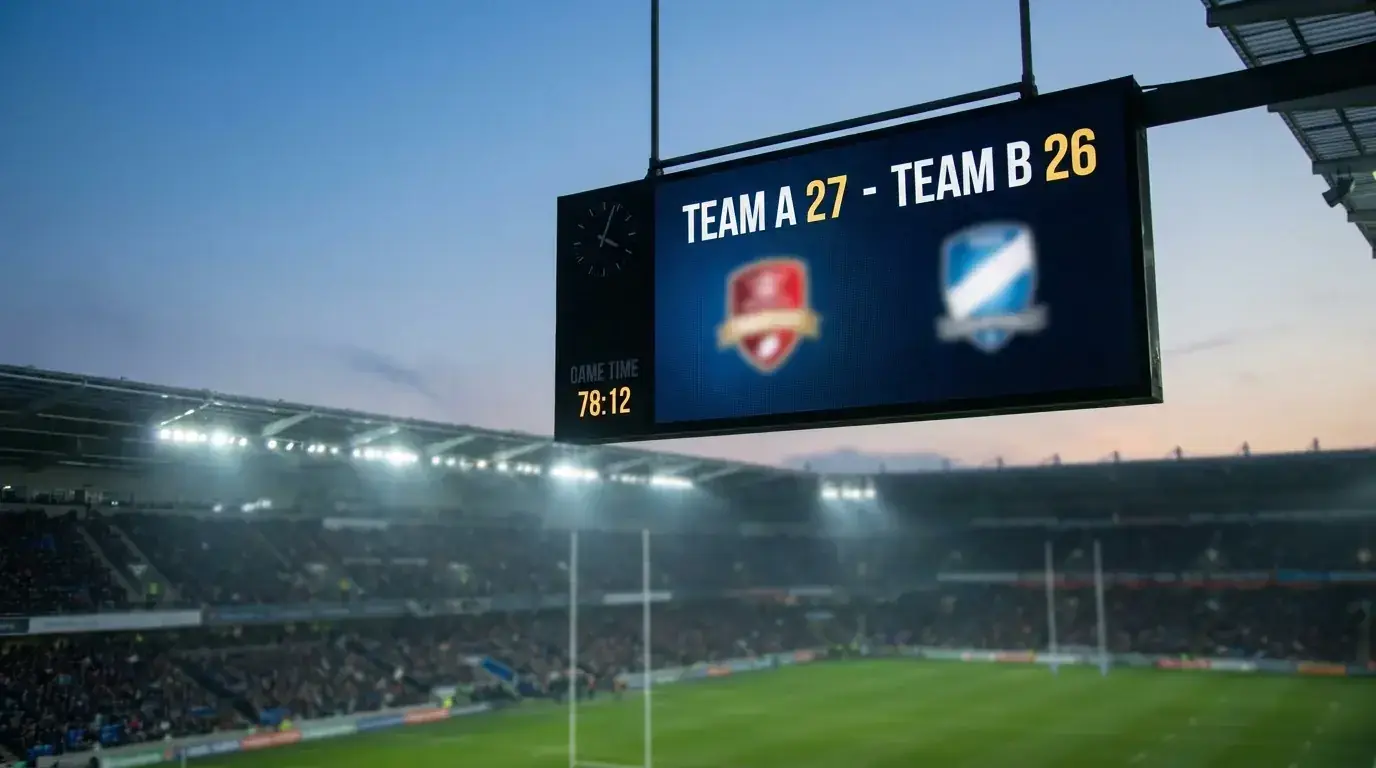
Bookmakers use half-point lines deliberately. They eliminate pushes, which means the book always settles every wager, and they slightly increase variance for the bettor. Whole-number lines tend to appear in less liquid markets — second-tier Super Rugby contests, MLR regular season — where the trader cannot afford to fine-tune the price.
My rule of thumb: half-point lines are sharper, whole-number lines are softer. When I see a whole-number rugby handicap on a major market, I assume the book is hedging against information it does not have. That is sometimes — not always — where edge hides.
Asian handicap in rugby
Asian handicap arrived in rugby from football, and it solves the push problem differently. Instead of one line, you get a split: a quarter-point handicap divides your stake across two adjacent lines. A -13.25 handicap effectively means half your money rides on -13, half on -13.5. A 13-point margin returns half your stake; a 14-point margin wins both halves.

Why bother? Because in rugby, where matches frequently settle exactly on multiples of seven (one converted try equals seven points) or three (a penalty), key numbers carry disproportionate weight. A -7 handicap on a tight match is loaded with push risk because tries plus conversions produce that exact margin constantly. Asian handicap softens that risk — at the cost of slightly worse odds on each half.
I use Asian handicaps when I have a strong view but accept that the exact margin is noise. I use straight handicaps when I have a clean read on the margin itself.
Line movement and what it tells you
A line that moves from -10.5 to -12.5 in the four hours before kick-off is broadcasting something. Either heavy money has arrived on the favourite, or team news has tilted the matchup. Sharp bettors read line movement the way a trader reads order flow: the size and timing of the move matter more than its direction.
The average number of active monthly accounts at the largest UK online operators climbed to 12.7 million in Q1 2025/26, which means the volume of money flowing through these books is enormous — and the line reflects all of it. When a Saturday Premiership handicap shifts two full points overnight, that is not noise. That is information.
The trick is distinguishing public moves from sharp moves. Public moves happen close to kick-off, on popular sides, in small increments. Sharp moves happen earlier, on the unfashionable side, and in larger jumps. If a line moves toward the underdog on Friday afternoon while every casual punter is still backing the favourite, somebody who models matches for a living has placed serious money on the side the crowd is ignoring.
Worked examples that make the maths concrete
Take a Six Nations fixture: England favoured at home against Italy, handicap set at -23.5. The implied trader’s median expectation is England by about 24 points. To beat the line, England need to score the equivalent of a converted try and a penalty more than the model expects.

Now compare two real-feeling scenarios. In the first, England score four tries to one, win 31-10, and cover comfortably. In the second, England score five tries to two, win 38-19, and cover by a similar margin — but the underlying performance was worse. The handicap rewards margin, not narrative. A 21-point win against a tame side covers less impressively than a 21-point win against one playing well.
Now flip it to NRL. A top-of-the-table side is -14.5 against a wooden-spoon contender on a wet Friday night. The conditions compress the score, the underdog has every reason to play conservative percentage rugby, and the favourite cannot run away with the game. The line on paper looks generous; the conditions on the ground make it a coin flip.
Roughly 5% of all global sports bettors stake on rugby, with match-outcome and margin betting together making up the lion’s share. Those two markets — and the handicap sits at the heart of margin betting — are where the bulk of the recreational money is mispriced, because most casual punters back narratives rather than numbers.
Reading the market on match day
The closer you get to kick-off, the more efficient the line becomes. Two hours before a Premiership match, the bookmaker has consumed the team sheets, the weather, the latest injury news and every meaningful piece of sharp action. By that point, beating the close is genuinely hard.

The early lines, opened on Sunday or Monday for a Saturday match, are where most of my edge has historically lived. They reflect a trader’s first guess rather than a market consensus. If you have a process — your own power rating, your own travel and rest adjustment — you can find lines that disagree with you by two or three points. Those gaps disappear by Friday.
If you want to go deeper on how news shocks reshape these prices, I cover the mechanics in my piece on rugby line movement around team news.
Where handicap betting goes sideways for casual punters
Three mistakes I see constantly. First, treating the handicap as a moneyline with extra points — backing the favourite at -14.5 because they “should win by twenty” without modelling the actual margin distribution. Second, chasing line moves toward the favourite, which is almost always public money rather than sharp money. Third, ignoring the bench. A Premiership side rotating its starting front row for a midweek European fixture is not the same side that won by twenty the previous Saturday.
Handicap betting rewards a process. Build a margin model, even a crude one. Track your closing line value. Stop pretending the moneyline is the only market that matters on a one-sided fixture, because that is the moment the handicap is doing its real work.
